“Why can’t you just use the bread we already have?” my nine-year-old nephew asked, pointing at the half-eaten loaf of sourdough focaccia sitting on the counter. I was mid-sentence, explaining my grand plan to buy cubes of stale bread for Thanksgiving stuffing, and I stopped. I started to explain why that wouldn’t work — then stopped. He was right. Why was I about to spend money on bread when there was perfectly good, slightly stale focaccia right there? I felt a little sheepish, honestly. I’d been overthinking it, stuck in my “traditional stuffing bread” mindset, while a kid saw the obvious solution. That Thanksgiving, we made the best stuffing of my life, and it wasn’t because of some fancy chef trick. It was because I finally listened to a nine-year-old. This kid-approved sourdough focaccia stuffing with sage and butter became an instant family legend, and let me tell you, it’s the only way I make it now.
Why You’ll Love This Recipe
This isn’t just another stuffing recipe — it’s the one that gets requested every single year, and for good reason. I’ve tested it on picky eaters, holiday skeptics, and even my mother-in-law who “doesn’t like stuffing.” It won them all over. Here’s why this sourdough focaccia stuffing stands out:
- Family-Approved Budget Hero: Uses day-old focaccia you probably already have, saving you a trip to the store and a few dollars.
- Simple Ingredients: No fancy grocery hauls. Butter, sage, onions, celery, and that leftover bread — that’s it.
- Perfect for Thanksgiving (or Any Family Dinner): It’s hearty enough for the big feast but easy enough for a Sunday roast.
- Picky Eater Magic: The crispy edges and buttery flavor make it a hit with kids who usually push stuffing around their plate.
- Reheats Like a Dream: Leftovers (if there are any) taste even better the next day, which is a lifesaver for busy families.
What makes this recipe different? It’s the texture. Sourdough focaccia has this incredible chewiness that regular bread cubes just don’t have. When it soaks up the broth and butter, it stays tender on the inside but gets gloriously crispy on the edges. I’ve tried every trick — toasting the cubes, using different broths — and nothing beats this. It’s the kind of stuffing that makes you close your eyes after the first bite, honestly. It’s comfort food reimagined: cheaper, easier, and somehow more satisfying than the classic version.
What Ingredients You Will Need
This recipe uses simple, wholesome ingredients to deliver big flavor without the fuss. Most of these are pantry staples, especially if you’ve already got a loaf of sourdough focaccia sitting around. Here’s what you’ll need:
- Day-old sourdough focaccia (about 1 pound, cut into 1-inch cubes) — The slightly stale texture is perfect for soaking up flavors without turning mushy. I usually use leftover focaccia from a local bakery, but any good sourdough works.
- Unsalted butter (1/2 cup, or 1 stick) — Adds richness and helps the edges get golden and crispy. I prefer Kerrygold for its creamy flavor, but any unsalted butter will do.
- Fresh sage leaves (1/4 cup, finely chopped) — The star herb here. Don’t use dried sage — fresh has a milder, more aromatic flavor that kids actually enjoy. If you have a garden, snip some right before cooking.
- Yellow onion (1 large, diced) — Adds sweetness and depth. White or red onion can work, but yellow is my go-to for its balanced flavor.
- Celery stalks (3 large, diced) — That classic stuffing crunch. If you’re out of celery, you can skip it, but the texture won’t be the same.
- Low-sodium chicken or vegetable broth (2 cups) — Keeps the stuffing moist without making it salty. I use Swanson’s low-sodium chicken broth because it’s reliable and affordable. For a vegetarian version, use vegetable broth.
- Large eggs (2, lightly beaten) — Helps bind everything together so it holds its shape when baked. No eggs? Try a flax egg (1 tablespoon ground flaxseed mixed with 3 tablespoons water per egg).
- Salt and black pepper (1 teaspoon salt, 1/2 teaspoon pepper, or to taste) — Simple seasonings that let the sage and butter shine.
- Optional: Fresh parsley (2 tablespoons, chopped) — For a pop of color and freshness at the end. Totally optional, but nice if you have it.
Ingredient Selection Tip: For the best texture, look for a focaccia that’s a day or two old. If your bread is fresh, cube it and spread it on a baking sheet in a 300°F oven for 10 minutes to dry it out slightly. This prevents soggy stuffing.
Equipment Needed
You don’t need a fully stocked kitchen for this recipe — just a few basics. Here’s what I use:
- Large skillet or sauté pan (12-inch) — For cooking the onions, celery, and sage in butter. A non-stick or stainless steel pan works fine.
- 9×13-inch baking dish — The standard size for this stuffing. If you don’t have one, a 10-inch cast-iron skillet works beautifully and gives you extra crispy edges.
- Large mixing bowl — For combining the bread cubes, vegetables, and broth mixture. I use a big stainless steel bowl, but any large bowl will do.
- Wooden spoon or spatula — For stirring without scratching your pan. I have a well-loved wooden spoon that’s seen many Thanksgivings.
- Sharp knife and cutting board — For dicing the onion and celery. A good chef’s knife makes this step quick and painless.
- Measuring cups and spoons — For accuracy, especially with the broth and butter. I’m usually a “by eye” cook, but for stuffing, precision matters.
Budget-Friendly Tip: If you don’t have a 9×13 dish, you can use a 10-inch cast-iron skillet or even a 9-inch square pan — just adjust the baking time by 5-10 minutes. No need to buy new equipment!
Preparation Method

Let’s get cooking. This recipe comes together in about 45 minutes, with most of that being hands-off baking time. Here’s how to make the best kid-approved sourdough focaccia stuffing:
- Preheat your oven to 375°F (190°C). Position the rack in the middle. While it heats, grease your 9×13 baking dish with a little butter or cooking spray — this prevents sticking and adds flavor.
- Toast the focaccia cubes. Spread the day-old focaccia cubes on a large baking sheet in a single layer. Bake for 10-12 minutes, until they’re dry and just starting to turn golden. This step is crucial — it keeps the cubes from turning into mush when you add the broth. Let them cool slightly while you work on the vegetables.
- Cook the aromatics. In a large skillet over medium heat, melt the 1/2 cup of unsalted butter. Add the diced onion and celery, and cook for 6-8 minutes, stirring occasionally, until the onions are translucent and the celery is tender. You’ll smell that sweet, buttery aroma — that’s the good stuff.
- Add the sage. Stir in the chopped fresh sage and cook for another minute, until fragrant. Don’t skip this — fresh sage needs a little heat to release its oils. If you’re using dried sage (not recommended), add it with the broth instead.
- Combine the bread and vegetables. In your large mixing bowl, combine the toasted focaccia cubes and the cooked onion-celery-sage mixture. Toss gently with a wooden spoon to distribute everything evenly. Be careful not to break the bread cubes — you want some texture.
- Make the broth mixture. In a separate bowl or large measuring cup, whisk together the 2 cups of low-sodium broth and the 2 lightly beaten eggs. Season with 1 teaspoon salt and 1/2 teaspoon black pepper. The eggs help bind the stuffing, giving it that perfect sliceable texture.
- Pour and toss. Slowly pour the broth mixture over the bread cube mixture, tossing gently as you go. You want every cube to get a little moistened, but not soaked. Let it sit for 5 minutes — the bread will absorb the liquid. If it looks too dry, add a splash more broth. If it’s too wet, add a few more toasted bread cubes.
- Transfer to the baking dish. Spoon the mixture into your prepared 9×13 dish and spread it into an even layer. Don’t press it down — you want some air pockets for crispy edges. Drizzle any remaining butter from the skillet over the top for extra flavor.
- Bake until golden. Bake for 25-30 minutes, until the top is golden brown and crispy. For extra crunch, broil for the last 2-3 minutes — watch it closely so it doesn’t burn. The stuffing should be set in the center and slightly jiggly, but not wet.
- Rest and serve. Let the stuffing cool for 5-10 minutes before serving. This allows it to set completely. Garnish with fresh parsley if you like, and dig in!
Sensory Cue: When it’s done, the top should be crispy and golden, and you’ll smell the sage and butter filling your kitchen. The edges will be dark and caramelized — those are the best bites.
Cooking Tips & Techniques
I’ve made this stuffing more times than I can count, and I’ve learned a few things the hard way. Here are my top tips for success:
- Don’t skip toasting the bread. I once tried to save time by using fresh focaccia, and the stuffing turned into a soggy mess. Toasting dries out the bread so it can absorb the broth without falling apart. Trust me on this one.
- Use low-sodium broth. Regular broth can make the stuffing overly salty, especially since the focaccia already has salt. Low-sodium gives you control. You can always add more salt at the end.
- Let the mixture rest before baking. That 5-minute rest after adding the broth is key. It gives the bread time to soak up the liquid evenly. If you bake it right away, you’ll end up with dry spots.
- Watch the oven closely. Every oven runs differently. My old oven used to burn the top while the middle was still wet. If that happens, cover the dish with foil for the first 20 minutes, then remove it for the last 10 to crisp up.
- Make it ahead. This stuffing is perfect for meal prep. Assemble it the night before (through step 8), cover it, and refrigerate. Bake it the next day, adding 10-15 minutes to the cooking time. It’s a lifesaver on Thanksgiving morning.
Variations & Adaptations
This recipe is flexible — here are some ways to make it your own:
- Vegetarian Version: Use vegetable broth instead of chicken broth. Add 1 cup of sautéed mushrooms for extra umami. My sister-in-law loves this version, and she says it’s even better than the original.
- Gluten-Free Option: Use gluten-free sourdough focaccia (many bakeries make it now). The rest of the ingredients are naturally gluten-free, so just swap the bread. Check your broth too — some brands add gluten.
- Add Some Meat: For a heartier stuffing, cook 1/2 pound of Italian sausage or bacon, crumble it, and stir it in with the vegetables. My neighbor swears by adding crispy pancetta. It’s amazing, but honestly, the original is already so good.
- Herb Swap: If you don’t have fresh sage, use a mix of fresh thyme and rosemary. I did this once when my sage plant died, and it was a happy accident. The flavor is more earthy but still delicious.
- Extra Crunch: Add 1/2 cup of toasted pecans or walnuts to the mixture before baking. The crunch is a nice contrast to the soft bread. My nephew (the one who started this whole thing) loves this version.
Serving & Storage Suggestions
This stuffing is best served warm, straight from the oven. The crispy top and tender inside are a match made in heaven. Here’s how to make the most of it:
- Serving Temperature: Serve hot, but let it rest for 5-10 minutes so it holds its shape. I like to spoon it onto plates with a generous pat of butter on top — yes, more butter.
- Pairings: It’s perfect alongside roasted turkey, chicken, or even a simple roast pork. For a vegetarian meal, serve it with a hearty mushroom gravy and roasted vegetables. A crisp white wine like Sauvignon Blanc cuts through the richness nicely.
- Storage: Leftovers keep in the refrigerator for up to 4 days in an airtight container. The flavors actually meld together and get even better — I always make extra for this reason.
- Reheating: Reheat in a 350°F oven for 10-15 minutes to restore the crispy top. You can also microwave individual portions, but the texture won’t be as good. For a quick fix, reheat in a skillet with a little butter — it’s incredible.
- Freezing: This stuffing freezes beautifully. Assemble it completely (through step 8), freeze in the baking dish wrapped tightly in foil, then bake from frozen at 375°F for 45-50 minutes. It’s a game-changer for holiday prep.
Nutritional Information & Benefits
While this is a comfort food through and through, it does have some redeeming qualities. Here’s a rough estimate per serving (based on 8 servings):
- Calories: ~320 per serving
- Fat: 18g (mostly from butter, which is fine in moderation)
- Carbohydrates: 34g
- Protein: 7g
- Fiber: 2g
- Sodium: ~480mg (using low-sodium broth)
Health Benefits: Sourdough bread is easier to digest than regular bread because the fermentation process breaks down gluten and phytic acid. Sage has anti-inflammatory properties and is rich in vitamin K. Celery and onion add fiber and antioxidants. It’s not health food, but it’s a wholesome indulgence that’s worth every bite. I always remind myself that a little butter makes the vegetables taste better — and the kids eat them without complaint!
Conclusion
This kid-approved sourdough focaccia stuffing with sage and butter is proof that sometimes the best recipes come from listening to the people around you — even if they’re nine years old. It’s affordable, easy, and absolutely delicious. I love how it brings everyone to the table, from picky eaters to stuffing purists. The crispy edges, the tender center, the buttery sage flavor — it’s everything I want in a holiday dish. I hope you give it a try and make it your own. Maybe add some nuts, maybe swap the herbs, maybe serve it with a big dollop of cranberry sauce. Whatever you do, let me know how it turns out! Drop a comment below or tag me in your photos — I’d love to see your version. Happy cooking, friends!
Frequently Asked Questions
Can I use regular sourdough bread instead of focaccia?
Yes, but the texture will be different. Focaccia is softer and has more air pockets, which gives the stuffing a lighter, fluffier texture. If you use regular sourdough, toast it a little longer to dry it out, and expect a denser result.
How do I make this stuffing dairy-free?
Swap the butter for a plant-based butter or olive oil. I’ve used olive oil before, and it adds a nice fruity note. Use a dairy-free milk or broth for the liquid. It won’t be as rich, but it’s still delicious.
Can I make this stuffing in a slow cooker?
Absolutely! Assemble the stuffing as directed, then transfer it to a greased slow cooker. Cook on low for 3-4 hours or on high for 1.5-2 hours. The top won’t get crispy, but you can broil it in the oven for a few minutes before serving.
Why is my stuffing soggy?
Soggy stuffing usually means too much liquid or bread that wasn’t toasted enough. Next time, reduce the broth by 1/4 cup and toast the bread cubes until they’re completely dry. Let the mixture rest for 5 minutes before baking to check the moisture level.
Can I add dried fruit or nuts?
Yes! Dried cranberries, chopped apples, or toasted pecans are all great additions. Stir them in with the vegetables. I like adding dried apricots for a sweet-tart contrast — it’s a nice surprise in every bite.
Pin This Recipe!
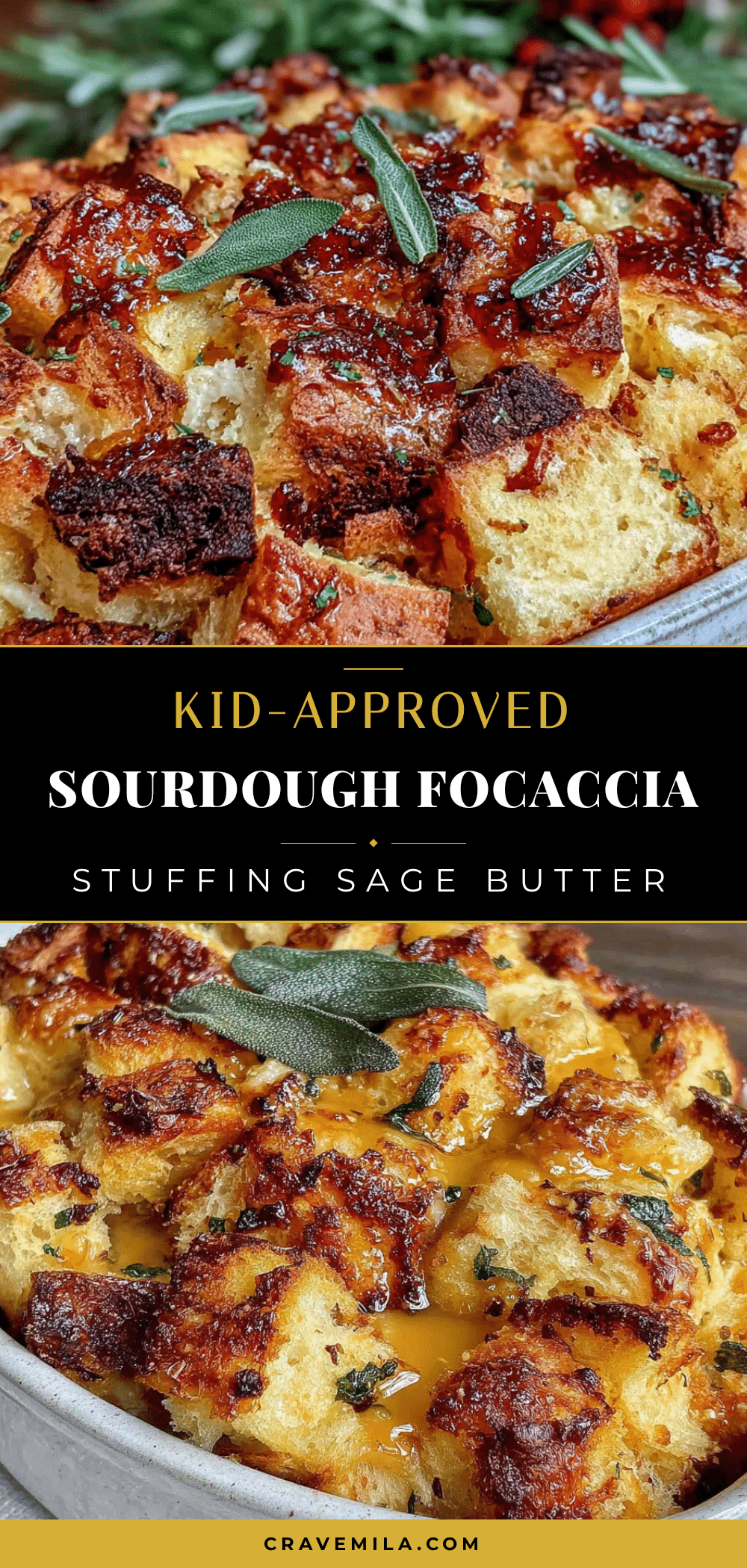
Kid-Approved Sourdough Focaccia Stuffing: Best Easy Recipe

This kid-approved sourdough focaccia stuffing with sage and butter is proof that sometimes the best recipes come from listening to the people around you. It’s affordable, easy, and absolutely delicious, with crispy edges, a tender center, and buttery sage flavor.
- Prep Time: 15 minutes
- Cook Time: 30 minutes
- Total Time: 45 minutes
- Yield: 8 servings 1x
- Category: Side Dish
- Cuisine: American
Ingredients
- 1 pound day-old sourdough focaccia, cut into 1-inch cubes
- 1/2 cup unsalted butter (1 stick)
- 1/4 cup fresh sage leaves, finely chopped
- 1 large yellow onion, diced
- 3 large celery stalks, diced
- 2 cups low-sodium chicken or vegetable broth
- 2 large eggs, lightly beaten
- 1 teaspoon salt
- 1/2 teaspoon black pepper
- 2 tablespoons fresh parsley, chopped (optional)
Instructions
- Preheat your oven to 375°F (190°C). Grease a 9×13-inch baking dish with butter or cooking spray.
- Spread the focaccia cubes on a large baking sheet in a single layer. Bake for 10-12 minutes until dry and just starting to turn golden. Let cool slightly.
- In a large skillet over medium heat, melt the butter. Add the diced onion and celery, and cook for 6-8 minutes until onions are translucent and celery is tender.
- Stir in the chopped fresh sage and cook for another minute until fragrant.
- In a large mixing bowl, combine the toasted focaccia cubes and the cooked onion-celery-sage mixture. Toss gently.
- In a separate bowl, whisk together the broth, eggs, salt, and pepper.
- Slowly pour the broth mixture over the bread cube mixture, tossing gently. Let sit for 5 minutes.
- Spoon the mixture into the prepared baking dish and spread into an even layer. Drizzle any remaining butter from the skillet over the top.
- Bake for 25-30 minutes until the top is golden brown and crispy. For extra crunch, broil for the last 2-3 minutes.
- Let the stuffing cool for 5-10 minutes before serving. Garnish with fresh parsley if desired.
Notes
For the best texture, use day-old focaccia. If bread is fresh, cube and toast at 300°F for 10 minutes. Use low-sodium broth to control saltiness. Let the mixture rest 5 minutes before baking to allow even absorption. For make-ahead, assemble through step 8, refrigerate, and bake the next day, adding 10-15 minutes to cooking time.
Nutrition
- Serving Size: 1 serving (about 1 c
- Calories: 320
- Sugar: 3
- Sodium: 480
- Fat: 18
- Saturated Fat: 10
- Carbohydrates: 34
- Fiber: 2
- Protein: 7
Keywords: sourdough focaccia stuffing, Thanksgiving stuffing, easy stuffing recipe, kid-approved stuffing, sage and butter stuffing