There used to be this tiny wine bar tucked behind a vintage bookstore in the east end of town—Le Petit Corkscrew, they called it—that made the most incredible charcuterie board I’d ever seen. When they closed their doors two summers ago, I honestly felt a little lost. That place was our spot. My husband and I celebrated our anniversary there, we went after rough weeks, and once we even sat through a thunderstorm sipping cheap red wine while the owner kept bringing out extra cheese samples. When they disappeared, so did our go-to romantic date night. After seven tries—seven boards that were either too expensive, too complicated, or just plain disappointing—I finally cracked the code. This romantic budget-friendly date night charcuterie board for two is the result of that obsession, and let me tell you, it might even be better than the original.
I remember standing in the grocery store aisle after attempt number four, holding a block of cheese that cost more than our entire dinner budget, thinking there had to be a smarter way. The problem with most charcuterie boards you see online is they’re designed to impress Instagram, not real people eating real dinner at home. They use twelve kinds of cheese and imported meats that cost a small fortune. But here’s what I learned: a romantic date night board isn’t about quantity—it’s about intention. It’s about the little details that say “I thought about this” without saying “I spent my whole paycheck on this.”
So I started reverse-engineering that Le Petit Corkscrew magic. I watched what the owner did, how she paired flavors, how she made ordinary ingredients feel special. And honestly, the secret is simpler than you’d think. You don’t need fancy ingredients—you just need to know how to put them together. This board uses affordable grocery store finds, clever substitutions, and a few presentation tricks that make everything look way more expensive than it actually is. Maybe you’ve been there too, staring at a grocery bill wondering how a simple snack turned into a splurge. I promise, this one won’t do that to you. It’s the date night board that brings back that cozy, candlelit feeling without the restaurant price tag.
Why You’ll Love This Recipe
Let’s be real for a second—planning a romantic date night at home can feel like a lot of pressure. You want it to feel special, but you also don’t want to spend hours in the kitchen or blow your weekly grocery budget on fancy ingredients. This romantic budget-friendly date night charcuterie board for two solves all of that. It’s the kind of meal that feels like an event without feeling like a chore. I’ve tested this board with my husband at least a dozen times now, and it never fails to make us slow down, actually talk to each other, and enjoy the evening. Here’s why it works so well:
- Budget-Friendly Without Looking Cheap : This whole board comes together for under $25—sometimes under $20 if you shop smart. The trick is choosing two or three good-quality ingredients and letting them shine, rather than buying ten mediocre things.
- Ready in 15 Minutes : No cooking required. No oven to preheat, no complicated steps. Just arrange and serve. That means more time actually enjoying your date night, not stressing in the kitchen.
- Simple Ingredients You Can Find Anywhere : Everything on this board comes from a regular grocery store. No specialty shops, no expensive online orders, no hunting down obscure cheeses. I’ll show you exactly what to look for and what to skip.
- Perfect for a Cozy Night In : Whether it’s an anniversary, Valentine’s Day, or just a Tuesday that needs a little romance, this board sets the mood. Light some candles, open a bottle of wine, and you’ve got a date night that beats any restaurant.
- Crowd-Pleaser for Picky Eaters : The beauty of a charcuterie board is that everyone can pick what they like. My husband hates blue cheese, I’m not crazy about certain meats, but we both walk away happy because there’s something for each of us.
What makes this recipe different from all those expensive boards you see on social media is the strategy behind it. I’m not just throwing ingredients on a platter and hoping for the best. Every single item has a job—some add saltiness, some add sweetness, some add crunch. It’s all balanced so that every bite feels intentional. Plus, I’ve tested every substitution and shortcut so you don’t have to. This isn’t just another charcuterie board—it’s the one I’d serve to my own family on a night when we need to feel special without spending like it.
What Ingredients You Will Need
This recipe uses simple, wallet-friendly ingredients to deliver that romantic, elevated feel without the fuss. The key is choosing items that work double-duty—a cheese that pairs with both the fruit and the meat, a spread that adds richness without needing a second condiment, and a mix of textures that keeps every bite interesting. Here’s exactly what you’ll need:
For the Cheese (The Star of the Board)
- 4 ounces sharp cheddar , sliced into thin triangles (I recommend Tillamook or Cabot—they’re affordable and consistently good)
- 4 ounces brie , at room temperature (look for the double-cream variety, which is cheaper than triple-cream but still feels luxurious)
- 4 ounces salami , thinly sliced (genoa salami is my go-to—it’s salty, fatty, and doesn’t dry out on the board)
- 2 ounces prosciutto , torn into ribbons (you only need a few slices—this is your splurge ingredient, but a little goes a long way)
For the Accompaniments (The Supporting Cast)
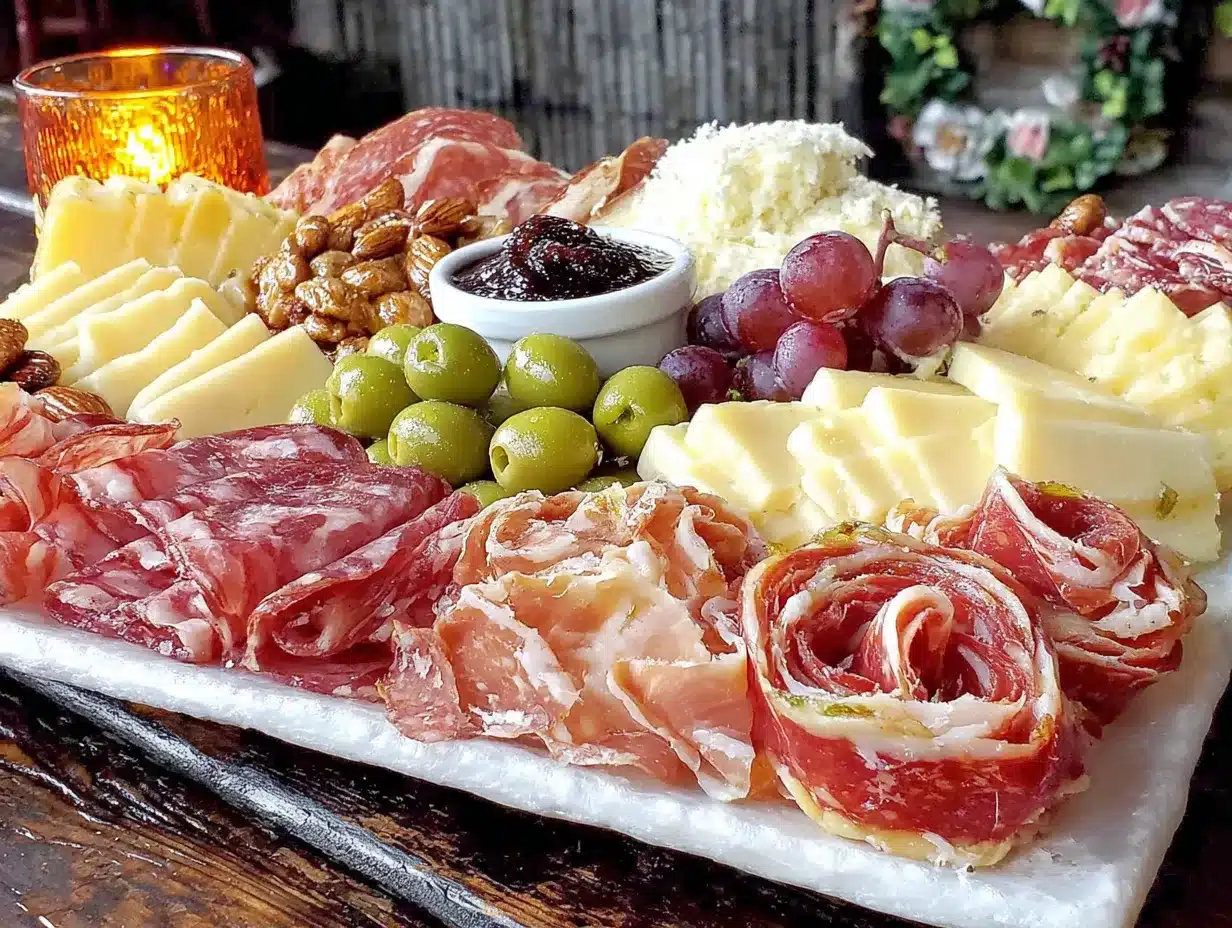
- 1/2 cup mixed olives (kalamata and green—buy from the olive bar at the grocery store to save money)
- 1/4 cup honey (local honey if you can find it—it adds that floral sweetness that makes brie taste like dessert)
- 1/4 cup fig jam or apricot preserves (fig jam is traditional, but apricot is cheaper and works just as well)
- 1 small baguette , sliced into thin rounds and lightly toasted (day-old baguettes work perfectly—just toast them a little longer)
- 1 cup mixed crackers (choose something neutral like water crackers or rosemary crackers—avoid anything too strongly flavored)
For the Fresh Elements (The Color and Crunch)
- 1 cup red grapes , washed and left in small clusters (they add sweetness and a pop of color)
- 1 apple (honeycrisp or fuji), sliced thin and tossed in lemon juice to prevent browning
- 1/4 cup dried apricots or dates (these add chewiness and natural sweetness—buy from the bulk bin to save money)
- 1/4 cup almonds or walnuts (raw or lightly toasted—toasting brings out their flavor and makes them feel more special)
Optional Extras (If Your Budget Allows)
- 1 small piece of dark chocolate (70% cocoa or higher—break it into pieces and tuck it between the cheese)
- Fresh rosemary or thyme sprigs (purely for decoration, but it makes the board look like it came from a fancy restaurant)
- Cornichons or pickled vegetables (these add acidity that cuts through the richness of the cheese and meat)
A quick note on substitutions: if you can’t find brie or it’s too expensive, swap in a soft goat cheese or even cream cheese mixed with a little honey. If prosciutto feels like too much of a splurge, just use more salami—honestly, nobody will notice. The beauty of this board is its flexibility. Use what you have, skip what you don’t, and don’t stress about perfection. The only non-negotiable is having something salty, something sweet, something creamy, and something crunchy. Everything else is negotiable.
Equipment Needed
You don’t need anything fancy to put this board together, and that’s part of the charm. Here’s what I use and what you can substitute if you don’t have the exact thing:
- A large wooden cutting board or serving platter (about 12×16 inches is ideal—a baking sheet lined with parchment paper works in a pinch)
- Small bowls or ramekins for the olives, honey, and jam (I use little ceramic dishes I picked up at a thrift store for 50 cents each)
- A sharp knife for slicing cheese and fruit (a serrated knife works best for baguette and brie)
- Cheese spreader or butter knife (not essential, but nice to have for the brie and jam)
- Small tongs for serving (optional, but they make the board feel more elegant)
One thing I learned the hard way: don’t use a plastic cutting board for this. It just doesn’t look as nice, and the cheese can stick to it. A wooden board or a ceramic platter makes everything look instantly more romantic. If you don’t have either, a large dinner plate works fine—just arrange everything in small, tight clusters.
Preparation Method
Alright, here’s where the magic happens. Follow these steps, and you’ll have a board that looks like it took hours to put together—when really, it took about fifteen minutes. I’ve included all the little tricks I learned from my failed attempts, so you can skip the mistakes I made.
- Start with the bowls. Place your small bowls or ramekins on the board first. This is a trick I learned from watching that wine bar owner—she always put the wet ingredients down first so they didn’t spill onto the cheese later. Fill one bowl with the olives, one with the honey, and one with the fig jam or apricot preserves. Space them out evenly across the board so there’s a natural flow from one to the next. If you’re using cornichons or pickled vegetables, put those in a fourth bowl.
- Add the cheese. Place the brie whole on the board—don’t slice it yet. Cutting into it too early makes it lose its shape and look messy. Put the cheddar slices in a fan shape next to the brie. Here’s a tip: fold the cheddar slices in half before fanning them out. It makes them look more substantial and creates nice visual lines. Leave a little space between the cheese and the bowls so nothing touches—it looks cleaner and more intentional.
- Layer the meat. Take your salami slices and fold each one in half, then in half again, so you get a little quarter-moon shape. Arrange them in a small cluster near one corner of the board. For the prosciutto, don’t fold it—tear it into irregular ribbons and let them drape loosely over the edge of the board or over a small piece of cheese. The irregularity looks rustic and romantic, like you just threw it together carelessly (even though you didn’t).
- Add the fruit and nuts. Place the grape clusters in two or three spots around the board. Don’t pull them apart into individual grapes—keeping them in small clusters looks more natural and makes the board feel abundant. Fan the apple slices in a line next to the cheddar. Scatter the dried apricots or dates in small piles near the cheese. Sprinkle the almonds or walnuts into any empty spaces—they fill gaps and add texture.
- Arrange the crackers and bread. This is where most people go wrong. Don’t just pile crackers in one spot—it looks lazy and makes it hard to reach them. Instead, fan the baguette slices along one edge of the board, and place the crackers in two or three small clusters around the cheese and meat. This way, every seated person can reach something without stretching across the table.
- Add the finishing touches. Drizzle a tiny bit of honey over the brie—just a little zigzag pattern, not a pool. Tuck a few fresh herb sprigs between the cheese and the fruit. If you’re using dark chocolate, break it into irregular pieces and scatter them near the grapes. Step back and look at your board. If there are any big empty spaces, fill them with extra crackers or a few more grapes. The goal is to make it look abundant, not sparse.
- Serve immediately. This board is best enjoyed within an hour of assembling. The cheese should be at room temperature (take it out of the fridge 30 minutes before serving), the bread should be crisp, and the fruit should be fresh. Set it in the middle of the table with two small plates, two napkins, and two glasses of wine. Light a candle. Put your phones away. That’s the whole point, right?
Cooking Tips & Techniques
I’ve made this board enough times to know exactly where things can go wrong. Here are the lessons I learned the hard way, so you don’t have to:
Room temperature cheese is non-negotiable. I cannot stress this enough. Cold brie tastes like nothing—it’s hard, bland, and disappointing. Take your cheese out of the fridge at least 30 minutes before you plan to serve. Same goes for the cheddar. Room temperature cheese has so much more flavor and spreads beautifully. I once forgot to do this and my husband politely ate the cold brie, but the whole board felt flat. Don’t make that mistake.
Toast your baguette slices. This is a tiny step that makes a huge difference. Spread the baguette slices on a baking sheet, brush them lightly with olive oil, and toast them at 375°F for about 5-7 minutes, until they’re golden around the edges. They stay crispy for hours and add that satisfying crunch that contrasts with the soft cheese. If you skip this step, the bread gets stale and rubbery within 20 minutes.
Balance your bites. The secret to a great charcuterie board is that every bite should have a little bit of everything. When you arrange the board, think about the journey your taste buds will take. Start with something salty (salami), then something creamy (brie), then something sweet (honey or fruit), then something acidic (olive or cornichon). If everything is salty or everything is sweet, the board gets boring fast.
Don’t overcrowd the board. I know it’s tempting to pile everything on, but a crowded board looks messy and makes it hard to pick things up without knocking something over. Leave a little space between items—it looks more elegant and makes each ingredient feel intentional. If you have more ingredients than fit, just use a smaller amount of each or put some in a separate bowl on the side.
Prep everything before you start arranging. Slice the cheese, toast the bread, wash the grapes, and tear the prosciutto before you put anything on the board. Once you start arranging, you want to work quickly so the cheese doesn’t warm up unevenly and the bread doesn’t get soggy. I learned this the hard way when I had to stop mid-arrangement to slice an apple and everything got messy.
Variations & Adaptations
One of the best things about this board is how easy it is to adapt. Here are some variations I’ve tried and loved:
Vegetarian Version: Skip the salami and prosciutto entirely. Add extra cheese (try a soft goat cheese or a smoked gouda) and double up on the vegetables. Roasted red peppers, marinated artichoke hearts, and grilled zucchini slices all work beautifully. I made this version for my sister who’s vegetarian, and she said it was the best charcuterie board she’d ever had.
Gluten-Free Adaptation: Replace the baguette and crackers with gluten-free crackers, rice cakes, or slices of cucumber and bell pepper. The cucumber adds a refreshing crunch that pairs surprisingly well with brie. Just pat the cucumber slices dry with a paper towel before arranging so they don’t make the board watery.
Seasonal Twist: In the summer, swap the apple for fresh figs or sliced peaches. In the fall, add roasted pumpkin seeds and a drizzle of maple syrup instead of honey. In the winter, use pomegranate seeds and a sprinkle of cinnamon over the brie. The board is endlessly adaptable to whatever looks good at the farmers market or grocery store.
Spicy Version: If you and your date like heat, add a small bowl of spicy honey (mix honey with a pinch of cayenne pepper) and swap the salami for soppressata or chorizo. A few pickled jalapeños on the side add a nice kick that cuts through the richness of the cheese.
Budget-Friendly Swap: If even this board feels like too much, simplify it even further. Use just one cheese (cheddar or gouda), one meat (salami), and a handful of crackers. Add an apple and some honey, and you’ve still got a romantic, intentional board for under $15. I’ve done this on weeks when money was tight, and honestly, it still felt special.
Serving & Storage Suggestions
This board is best served immediately, at room temperature, with the cheese soft and the bread crisp. But life happens, and sometimes you need to make things ahead or save leftovers. Here’s what I do:
Serving Temperature: Serve everything at room temperature except the grapes and apple slices (keep those cool for freshness). If you’re serving outdoors on a warm evening, keep the cheese in the fridge until the last minute and add a small ice pack under the board to keep things from getting too soft.
What to Serve With It: A crisp white wine like Sauvignon Blanc or a light red like Pinot Noir pairs beautifully with this board. If you’re not drinking wine, sparkling water with a splash of cranberry juice and a rosemary sprig feels just as festive. For dessert, keep it simple—a few squares of dark chocolate or a small bowl of fresh berries.
Storage: Leftovers can be stored separately in airtight containers in the refrigerator. The cheese will keep for 3-4 days, the meat for 2-3 days, and the fruit for 1-2 days. The crackers and bread will get soft if stored with the other ingredients, so keep them in a separate bag at room temperature.
Reheating: Don’t reheat anything—just let the cheese come back to room temperature before serving again. If the bread has gone soft, pop it in a 350°F oven for 3-4 minutes to crisp it back up. The honey and jam don’t need any special treatment.
Flavor Development: Here’s something interesting—the flavors actually get better after a few hours at room temperature. The cheese softens, the honey soaks into the brie slightly, and the salami releases a little oil that mingles with the fruit. If you’re serving this for a dinner party, you can assemble the board up to an hour ahead and let it sit at room temperature. Just cover it loosely with plastic wrap to keep the bread from drying out.
Nutritional Information & Benefits
This board is meant to be shared, so the nutritional values are per serving (half the board). Keep in mind that these are estimates—the actual numbers will vary based on your specific ingredients and portion sizes.
| Nutrient | Amount Per Serving |
|---|---|
| Calories | 580-650 |
| Protein | 22g |
| Fat | 38g |
| Carbohydrates | 42g |
| Fiber | 5g |
| Sugar | 28g |
| Sodium | 1200mg |
From a health perspective, this board has some surprising benefits. The cheese provides calcium and protein, the nuts offer healthy fats and vitamin E, and the fruit adds antioxidants and fiber. The olives contain heart-healthy monounsaturated fats, and the honey has antibacterial properties. Is it a health food? No. But it’s a balanced meal that includes protein, fat, and carbs—plus it’s made from whole, minimally processed ingredients.
If you’re watching your sodium intake, use low-sodium crackers and skip the prosciutto. If you’re dairy-sensitive, swap the brie and cheddar for vegan cheese alternatives or increase the nuts and olives for richness. This board is naturally gluten-free if you choose the right crackers, and it’s easy to make vegetarian by omitting the meat.
Conclusion
Look, I know a charcuterie board isn’t exactly a recipe in the traditional sense. There’s no oven involved, no complicated techniques, nothing that would impress a chef. But sometimes the most romantic meals aren’t about showing off your cooking skills—they’re about creating a moment. A moment where you sit down across from someone you love, you share good food, and you actually talk to each other without distractions. That’s what this board is for.
I still think about Le Petit Corkscrew sometimes, especially on rainy evenings. But honestly? I don’t miss it the way I used to. Because now I can make that feeling at home, for a fraction of the cost, and I can customize it exactly the way we like it. This romantic budget-friendly date night charcuterie board for two has become our little tradition—the thing we do when we need to remember why we chose each other in the first place.
So go ahead and make this board your own. Swap in your favorite cheese, use whatever fruit looks good at the store, and don’t stress about getting it perfect. The only thing that matters is that you’re sharing it with someone you care about. And if you come up with a variation you love, I’d honestly love to hear about it. Drop a comment below or tag me in your photos—nothing makes me happier than seeing people make this board their own. Now go light that candle and pour that wine. You deserve it.
Frequently Asked Questions
Can I make this charcuterie board ahead of time?
You can prep most of the ingredients ahead of time, but I recommend assembling the board no more than an hour before serving. Slice the cheese and fruit, toast the bread, and wash the grapes up to a day in advance—just store everything separately in the fridge. When you’re ready to serve, let the cheese come to room temperature for 30 minutes, then arrange everything on the board. The bread will stay crisp if you keep it in a sealed bag until the last minute.
How do I keep the apple slices from turning brown?
Toss the apple slices in a little lemon juice or lime juice right after you cut them. The acid prevents oxidation and keeps them looking fresh for hours. You can also use a solution of one part honey to three parts water—just brush it lightly over the slices. I’ve used both methods, and they work equally well. Just pat the slices dry before putting them on the board so they don’t make everything sticky.
What’s the best wine to pair with this board?
A light red like Pinot Noir or Beaujolais works beautifully because it doesn’t overpower the cheese or meat. If you prefer white wine, go with a Sauvignon Blanc or a dry Riesling—the acidity cuts through the richness of the brie and salami. For a non-alcoholic option, sparkling water with a splash of pomegranate juice and a rosemary spig is elegant and refreshing. Honestly, the best wine is whatever you and your date enjoy drinking—don’t overthink it.
How do I keep the board from looking messy?
The secret is to group ingredients by type and leave a little space between each group. Don’t scatter everything randomly—place the cheese in one area, the meat in another, the fruit in a third. Use small bowls for anything wet or sticky (olives, honey, jam) so they don’t leak onto the other ingredients. And don’t overcrowd the board—if you have too many ingredients, use a smaller amount of each or put some in a separate bowl on the side. A little negative space makes everything look more intentional.
Can I use different cheeses and meats?
Absolutely. This board is endlessly customizable. If you don’t like brie, use goat cheese or camembert. If salami isn’t your thing, try prosciutto, soppressata, or even sliced turkey breast (though that’s less traditional). The key is to have a mix of textures—one soft cheese, one firm cheese, one salty meat, and one mild meat. As long as you have that balance, you can use whatever you like or whatever’s on sale at the grocery store.
Pin This Recipe!
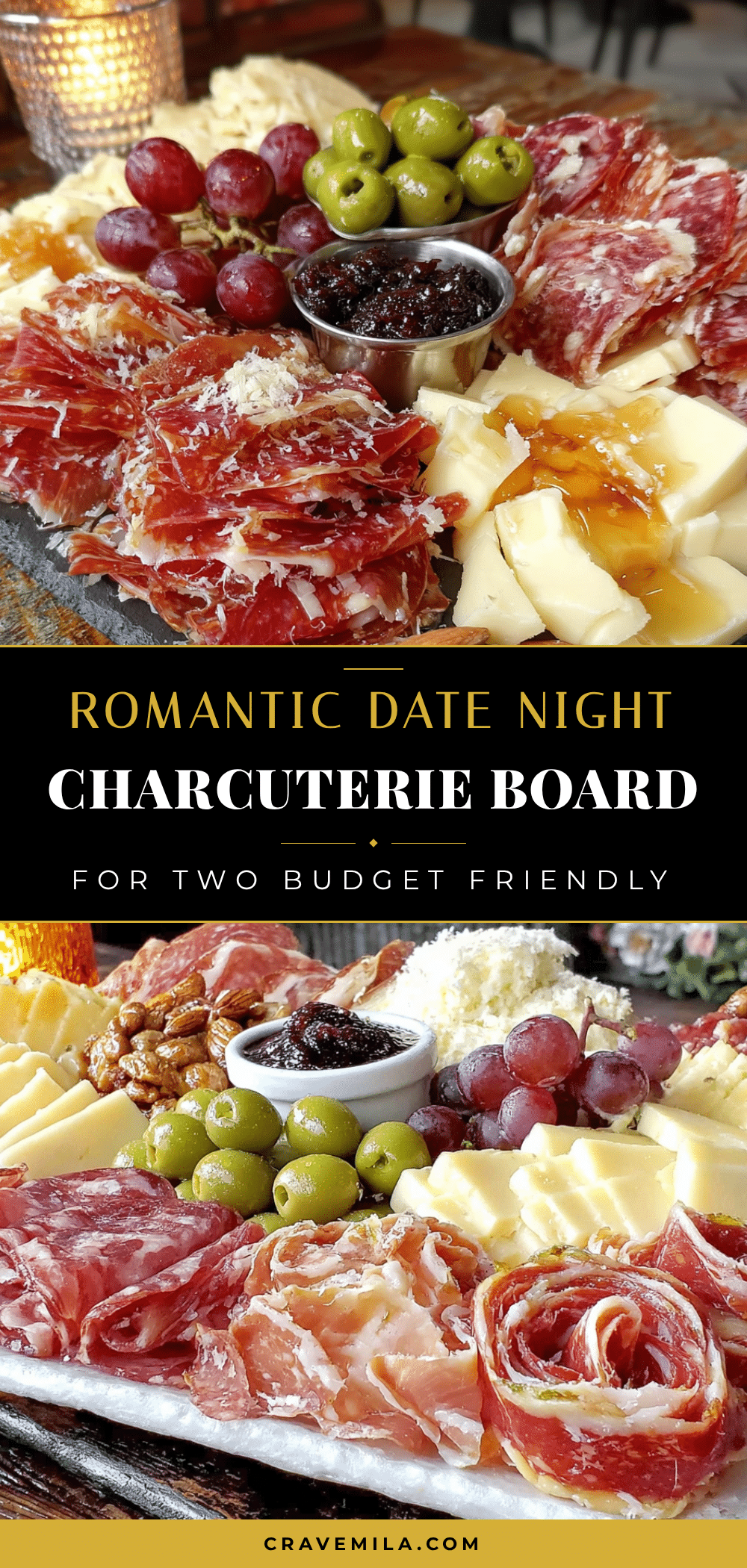
Romantic Budget-Friendly Date Night Charcuterie Board for Two
A romantic and budget-friendly charcuterie board for two, featuring affordable grocery store finds and clever presentation tricks that make it feel special without breaking the bank. Ready in 15 minutes, it’s perfect for a cozy night in.
- Prep Time: 15 minutes
- Cook Time: 0 minutes
- Total Time: 15 minutes
- Yield: 2 servings 1x
- Category: Appetizer
- Cuisine: French
Ingredients
- 4 ounces sharp cheddar, sliced into thin triangles
- 4 ounces brie, at room temperature
- 4 ounces salami, thinly sliced
- 2 ounces prosciutto, torn into ribbons
- 1/2 cup mixed olives (kalamata and green)
- 1/4 cup honey
- 1/4 cup fig jam or apricot preserves
- 1 small baguette, sliced into thin rounds and lightly toasted
- 1 cup mixed crackers
- 1 cup red grapes, washed and left in small clusters
- 1 apple (honeycrisp or fuji), sliced thin and tossed in lemon juice
- 1/4 cup dried apricots or dates
- 1/4 cup almonds or walnuts
- 1 small piece of dark chocolate (70% cocoa or higher) (optional)
- Fresh rosemary or thyme sprigs (optional)
- Cornichons or pickled vegetables (optional)
Instructions
- Start with the bowls. Place small bowls or ramekins on the board first. Fill one with olives, one with honey, and one with fig jam or apricot preserves. Space them out evenly.
- Add the cheese. Place the brie whole on the board. Fan the cheddar slices next to the brie, folding them in half for a more substantial look. Leave space between cheese and bowls.
- Layer the meat. Fold salami slices in half twice to form quarter-moons and arrange in a small cluster. Tear prosciutto into irregular ribbons and drape loosely over the edge or over a small piece of cheese.
- Add the fruit and nuts. Place grape clusters in two or three spots. Fan apple slices next to the cheddar. Scatter dried apricots or dates in small piles near the cheese. Sprinkle almonds or walnuts into empty spaces.
- Arrange the crackers and bread. Fan baguette slices along one edge. Place crackers in two or three small clusters around the cheese and meat.
- Add the finishing touches. Drizzle a tiny bit of honey over the brie. Tuck fresh herb sprigs between cheese and fruit. If using dark chocolate, break into irregular pieces and scatter near grapes. Fill any empty spaces with extra crackers or grapes.
- Serve immediately. Enjoy within an hour of assembling. Set in the middle of the table with small plates, napkins, and glasses of wine.
Notes
Take cheese out of fridge 30 minutes before serving. Toast baguette slices for extra crunch. Don’t overcrowd the board; leave space between items. Prep all ingredients before arranging.
Nutrition
- Serving Size: Half the board
- Calories: 580650
- Sugar: 28
- Sodium: 1200
- Fat: 38
- Carbohydrates: 42
- Fiber: 5
- Protein: 22
Keywords: charcuterie board, date night, romantic dinner, budget-friendly, easy appetizer, cheese board, no-cook meal