My neighbor, a woman named Clara who’d been cooking for church suppers since before I was born, watched me struggle with a floppy, watery breakfast casserole one Sunday morning. She didn’t say anything at first. She just handed me a cup of coffee, waited for me to take a bite of my sad creation, and then said, “You’re overthinking it. Breakfast casserole isn’t a science project—it’s a conversation between the ingredients.”
She came over the next Saturday with a grocery bag and a cast iron skillet. No written recipe, just her hands measuring things and her voice narrating the process. “Let the sausage talk first,” she said, as the grease popped. “Then listen to the eggs.” I honestly thought she was being poetic, but she meant it literally—she wanted me to watch how the eggs absorbed the fat and the cheese settled into the milk. It was the most patient I’d ever been in a kitchen, and the result was this Ultimate Loaded Sausage Breakfast Casserole.
I’ve tweaked it over the years, because that’s what you do with a recipe that feels like it belongs to you now. I added more cheese (obviously), swapped in different peppers depending on the season, and figured out the exact baking time that gives you that perfect golden top without drying out the edges. Maybe you’ve been there—staring at a soggy breakfast dish, wondering where you went wrong. This one fixes all of that. It’s the kind of casserole that stays with you, not just because it tastes good, but because it feels like someone handed you the secret to a calm, happy morning.
Why You’ll Love This Recipe
I’ve tested this casserole more times than I care to count—for brunches, holiday mornings, and even a few “I have nothing in the house” weeknights. Each time, it delivered. Here is why this version stands out from every other breakfast casserole you’ve tried:
- Make-Ahead Magic: Assemble it the night before, pop it in the fridge, and bake it fresh in the morning. No early morning chaos, no rushing around.
- Simple Ingredients: You probably have most of these in your kitchen right now. No weird specialty items or expensive cheeses.
- Crowd-Pleaser: I’ve served this to picky toddlers, hungry teenagers, and my dad who “doesn’t do casseroles.” Every single plate came back clean.
- Perfect for Any Occasion: Christmas morning, Easter brunch, lazy Saturdays, or meal prep for the week. It fits everywhere.
- Unbelievably Satisfying: The texture is what gets me every time—creamy eggs, crispy edges, melty cheese, and juicy sausage all in one forkful.
What makes this recipe different from the dozens of others out there? It’s the balance. Most breakfast casseroles are either too eggy, too bready, or too dry. This one hits that sweet spot because of how the ingredients are layered—not just dumped in a dish. The sausage gets a head start, the cheese is distributed in two layers, and the egg mixture is poured slowly so it seeps into every crevice. It’s not just another version. It is the version.
Honestly, this recipe is the kind that makes you close your eyes after the first bite. It’s comfort food reimagined—hearty, cheesy, and packed with flavor, but somehow still light enough that you don’t feel like you need a nap after breakfast. Perfect for impressing guests without stress, or turning a simple Saturday morning into something memorable.
What Ingredients You Will Need
This recipe uses simple, wholesome ingredients that work together to create bold flavor and that perfect, satisfying texture. Most of these are pantry staples, but I have a few notes on picking the best ones.
- 1 pound breakfast sausage (I recommend Jimmy Dean or a local butcher’s bulk sausage—avoid pre-cooked links here, you want the raw crumbles)
- 8 large eggs (room temperature if you remember, but cold works too—I’ve done both)
- 2 cups whole milk (adds richness; 2% works in a pinch but don’t go skim, it gets watery)
- 1 teaspoon Dijon mustard (trust me on this—it doesn’t taste like mustard, it just wakes up the eggs)
- 1/2 teaspoon garlic powder
- 1/2 teaspoon onion powder
- 1/2 teaspoon smoked paprika (regular paprika works, but smoked adds a subtle depth)
- 1/4 teaspoon black pepper
- 1/2 teaspoon salt (go easy—the sausage and cheese add salt too)
- 6 cups cubed bread (stale or day-old is best; I use a crusty sourdough or French bread—avoid soft sandwich bread, it turns to mush)
- 2 cups shredded sharp cheddar cheese (shred it yourself from a block—pre-shredded has anti-caking agents that mess with the melt)
- 1 cup shredded mozzarella cheese (for that stretchy, gooey factor)
- 1 medium onion, diced (yellow or white)
- 1 bell pepper, diced (any color—red adds sweetness, green adds a sharper note)
- 2 tablespoons unsalted butter (for greasing the dish and sautéing the veggies)
- Fresh chives or parsley for garnish (optional but pretty)
A quick note on substitutions: If you need a gluten-free option, use a sturdy gluten-free bread—I’ve had good luck with Schär’s artisan loaf. For a dairy-free version, swap the milk with unsweetened oat milk and use dairy-free cheese shreds (they melt differently, so add them in the last 10 minutes of baking). And if you’re watching the spice level, use mild Italian sausage instead of hot breakfast sausage.
Equipment Needed
You don’t need a fancy kitchen to pull this off. Here is what you’ll need:
- 9×13-inch baking dish (glass or ceramic works best for even heat distribution—I’ve used both Pyrex and a stoneware dish)
- Large skillet (for cooking the sausage and veggies—cast iron is my go-to, but non-stick works fine)
- Large mixing bowl (for whisking the eggs and milk)
- Whisk (a fork works in a pinch, but a whisk gets the eggs fluffier)
- Cutting board and sharp knife
- Measuring cups and spoons
- Aluminum foil (for covering the casserole during the first part of baking)
- Spatula or wooden spoon
If you don’t have a 9×13 dish, you can use two 8×8 square dishes—just reduce the baking time by about 10 minutes. I learned that the hard way when I forgot my dish at a friend’s house. Also, if you’re using a metal baking pan, keep an eye on the edges—they can brown faster than glass or ceramic.
Preparation Method

Let’s get cooking. This recipe comes together in about 30 minutes of active time, then the oven does the rest. Here is the step-by-step:
- Preheat your oven to 350°F (175°C). Grease your 9×13 baking dish with the 2 tablespoons of butter—don’t skip this, even if you have a non-stick dish. The eggs will thank you.
- Cook the sausage. In your large skillet over medium heat, add the pound of breakfast sausage. Break it up with a spatula as it cooks, letting it brown and get those crispy little bits. This takes about 6-8 minutes. Don’t drain all the fat—leave about a tablespoon in the pan for flavor. Use a slotted spoon to transfer the cooked sausage to a plate and set it aside.
- Sauté the veggies. In the same skillet with the remaining sausage drippings, add the diced onion and bell pepper. Cook over medium heat for 4-5 minutes until they soften and the onion turns translucent. You want them tender but not mushy—they’ll finish cooking in the oven. Scrape them into the dish with the sausage.
- Whisk the egg mixture. In your large mixing bowl, crack the 8 eggs. Add the 2 cups of milk, Dijon mustard, garlic powder, onion powder, smoked paprika, black pepper, and salt. Whisk vigorously for about 30 seconds until everything is well combined and slightly frothy on top. The mustard might seem weird, but it emulsifies the milk and eggs, giving you that creamy texture.
- Layer the bread. Spread the 6 cups of cubed bread evenly in the greased baking dish. Don’t pack it down—let it sit loosely so the egg mixture can get in between all those nooks and crannies.
- Add the sausage and veggies. Sprinkle the cooked sausage and sautéed onion-pepper mixture evenly over the bread cubes. Use your hands or a spoon to gently nestle some of it down into the bread—this ensures every bite has a little bit of everything.
- Layer the cheese. Sprinkle 1 cup of the shredded cheddar and 1/2 cup of the mozzarella over the sausage and bread. Reserve the rest for the top.
- Pour the egg mixture. Slowly pour the whisked egg mixture over everything in the dish. Take your time here—pour it in a zigzag pattern across the whole dish, then gently press down on the top with a spatula to help the liquid soak into the bread. Let it sit for 5 minutes at room temperature.
- Top with remaining cheese. Sprinkle the remaining 1 cup of cheddar and 1/2 cup of mozzarella over the top. This creates that gorgeous golden crust.
- Bake covered. Cover the dish with aluminum foil and bake for 30 minutes. The foil traps steam and cooks the inside evenly without burning the cheese.
- Bake uncovered. Remove the foil and bake for another 20-25 minutes, until the top is golden brown and bubbly, and the center is set (a knife inserted in the middle should come out clean). If you want extra browning, switch to broil for the last 2 minutes—but watch it closely, it goes from golden to burnt fast.
- Rest before serving. Let the casserole rest for 10 minutes after it comes out of the oven. This is the hardest part, I know, but it lets the eggs set fully so you get clean slices instead of a messy scoop. Garnish with fresh chives or parsley if you’re feeling fancy.
Cooking Tips & Techniques
After making this casserole about a dozen times, I’ve picked up a few tricks that make a real difference. Here are the ones I wish I’d known from the start:
Don’t overmix the eggs. I used to beat the eggs until they were completely uniform, thinking that was the right way. Turns out, a few streaks of white in the yolk mixture are fine—overmixing incorporates too much air, which can make the casserole puff up in the oven and then collapse into a dense mess. Just whisk until combined, about 20 seconds.
Let the bread stale naturally. If you have time, cube the bread and leave it out on a baking sheet overnight. Stale bread absorbs the egg mixture without turning into paste. If you’re in a hurry, spread the cubes on a baking sheet and bake at 300°F for 5-7 minutes to dry them out slightly. I learned this after one particularly soggy casserole that my kids politely called “breakfast pudding.”
Watch your baking time. Every oven runs differently. My old oven took exactly 50 minutes total. My new one? 45 minutes and it’s done. Start checking at the 40-minute mark—look for a golden top and a slight jiggle in the very center (it’ll set during the rest time). Overbaking dries out the eggs and you lose that creamy texture.
Make it ahead the right way. If you’re assembling this the night before, do everything except the final cheese layer. Add that right before baking. The cheese can get weird and oily if it sits in the fridge overnight. Also, let the casserole sit at room temperature for 20 minutes before baking if it’s straight from the fridge—cold dishes need about 10 extra minutes in the oven.
Use a thermometer if you’re nervous. The internal temperature should reach 160°F (71°C) when fully cooked. I don’t always use one, but when I’m serving a crowd, it gives me peace of mind.
Variations & Adaptations
This casserole is a great base recipe, and I’ve played around with it more than I care to admit. Here are some variations that actually work:
Spicy Southwest Version: Swap the breakfast sausage for chorizo, use pepper jack cheese instead of cheddar, and add a diced jalapeño (seeds removed unless you want heat) with the onions and peppers. Top with sliced avocado and a dollop of sour cream after baking. I made this for a game day brunch and it disappeared in 10 minutes.
Vegetarian Option: Skip the sausage and sauté 8 ounces of sliced mushrooms with the onions and peppers. Add a 10-ounce package of frozen spinach (thawed and squeezed dry) along with the veggies. The mushrooms give you that savory, umami flavor that replaces the meat beautifully. Use a vegetable-based milk like oat or soy for the egg mixture.
Low-Carb / Keto-Friendly: Replace the bread with 4 cups of frozen cauliflower florets (thawed, patted dry, and roughly chopped). The texture is different—less fluffy, more dense—but it satisfies that casserole craving without the carbs. Add an extra 1/2 cup of cheese to compensate for the missing bread richness.
Holiday Morning Special: Add 1/2 cup of cooked, crumbled bacon along with the sausage. Swap the bell pepper for 1/2 cup of diced roasted red peppers (from a jar, drained). Use a mix of cheddar and Gruyère for a more sophisticated flavor. This version feels extra special without being fussy.
Personal Variation I Love: One time I had leftover caramelized onions in the fridge, so I threw those in instead of fresh diced onion. It added a sweetness that paired perfectly with the smoky paprika. Now I make extra caramelized onions on purpose just for this casserole. It takes the flavor from good to “what did you put in this?”
Serving & Storage Suggestions
This casserole is best served warm, straight from the oven, with that cheese pull that makes everyone at the table stop and stare. Here is how to serve it and keep it for later:
Serving Temperature: Let it rest for 10 minutes after baking, then serve while still warm. Room temperature is also fine if you’re doing a brunch buffet—it holds up beautifully. I’ve even served it at a picnic once (wrapped in foil and towels) and it was still delicious an hour later.
Presentation Tips: Cut into squares or rectangles using a sharp knife—wipe the blade clean between cuts for neat edges. Serve on a platter with a sprinkle of fresh chives or parsley on top. A side of fresh fruit, a simple green salad, or roasted potatoes rounds out the meal nicely. For drinks, mimosas or a strong cup of coffee are the obvious choices.
Storage Instructions: Leftovers keep in an airtight container in the refrigerator for up to 4 days. The flavors actually meld together more overnight, so day-two casserole is almost better than fresh. To freeze, wrap individual portions tightly in plastic wrap, then foil, and store in a freezer bag for up to 3 months. Thaw overnight in the fridge before reheating.
Reheating Methods: The oven is your best bet for maintaining texture. Reheat at 300°F for 10-15 minutes for individual portions, or 20 minutes for a larger piece. The microwave works in a pinch (1-2 minutes on high), but the eggs can get rubbery. If you’re reheating from frozen, let it thaw first—reheating frozen can leave you with a cold center and burnt edges.
Flavor Development: Here is a secret—this casserole is actually better on day two. The bread fully absorbs the egg mixture, the flavors settle into each other, and the texture becomes more cohesive. I sometimes make it two days ahead on purpose. Don’t tell anyone, but I’ve been known to eat a cold slice straight from the fridge at midnight. It’s that good.
Nutritional Information & Benefits
Here is the estimated nutritional breakdown for one serving (based on 8 servings per casserole):
- Calories: 485
- Protein: 28g
- Fat: 32g
- Carbohydrates: 22g
- Fiber: 2g
- Sugar: 6g
- Sodium: 820mg
This casserole is packed with protein from the eggs, sausage, and cheese, making it a satisfying breakfast that keeps you full for hours. The eggs provide choline, which is great for brain health, and the bell peppers add a solid dose of vitamin C—about 30% of your daily needs per serving. The onions contribute prebiotic fiber that supports gut health.
If you’re watching your sodium, use low-sodium sausage and reduce the added salt to 1/4 teaspoon. For a lower-fat version, swap the whole milk for 2% and use reduced-fat cheese—it still tastes great, just slightly less indulgent. This recipe contains dairy and gluten, so it’s not suitable for those with celiac disease or dairy allergies without the substitutions I mentioned earlier.
Honestly, I don’t make this casserole for its health benefits—I make it because it makes people happy. But knowing it has some nutritional value makes me feel a little better about that second slice.
Conclusion
This Ultimate Loaded Sausage Breakfast Casserole is more than just a recipe—it’s the solution to every breakfast dilemma you’ve ever had. Too busy to cook in the morning? Make it ahead. Stressed about feeding a crowd? This dish handles it. Want something that tastes like you spent hours in the kitchen? The oven does all the work.
I love this recipe because it reminds me of Clara’s kitchen—the way she didn’t measure anything, the way she laughed when I asked for exact times, the way she said “you’ll know when it’s done.” She was right. And now, after making this casserole more times than I can count, I know it too. The golden top, the creamy center, the way the cheese stretches when you pull out a slice—that’s the sign.
I’d love to hear how this recipe turns out for you. Did you add your own twist? Did your kids ask for seconds? Did you eat it cold at midnight like I do? Drop a comment below and let me know. Share this recipe with someone who needs a good breakfast in their life, and don’t forget to tag me when you make it—I want to see those cheesy, golden slices!
Happy cooking, friends. You’ve got this.
Frequently Asked Questions
Can I use a different type of meat instead of breakfast sausage?
Absolutely. Ground pork, turkey sausage, or even cooked and crumbled bacon all work well. Just make sure whatever you use is fully cooked before layering it in the dish. If you use bacon, drain the excess fat so the casserole doesn’t get greasy.
Do I have to let the casserole sit overnight?
No, but it helps. The overnight rest allows the bread to fully absorb the egg mixture, resulting in a more cohesive texture. If you’re short on time, let it sit at room temperature for 20-30 minutes before baking—that’s enough to get a decent soak.
Can I use frozen vegetables instead of fresh?
You can, but thaw and drain them first. Frozen bell peppers and onions release a lot of water as they cook, which can make the casserole watery. I’ve used frozen pepper and onion blends in a pinch and just squeezed out the excess moisture with paper towels before adding them.
How do I know when the casserole is fully cooked?
The top should be golden brown and bubbly, and a knife inserted into the center should come out clean. The internal temperature should reach 160°F (71°C). If the top is browning too fast but the center is still jiggly, cover it loosely with foil and bake for another 10 minutes.
Can I double this recipe for a larger crowd?
Yes, but use two separate 9×13 dishes instead of one giant pan. Doubling the recipe in a single dish leads to uneven cooking—the edges will be dry before the center sets. Bake both dishes at the same time, rotating them halfway through for even results.
Pin This Recipe!
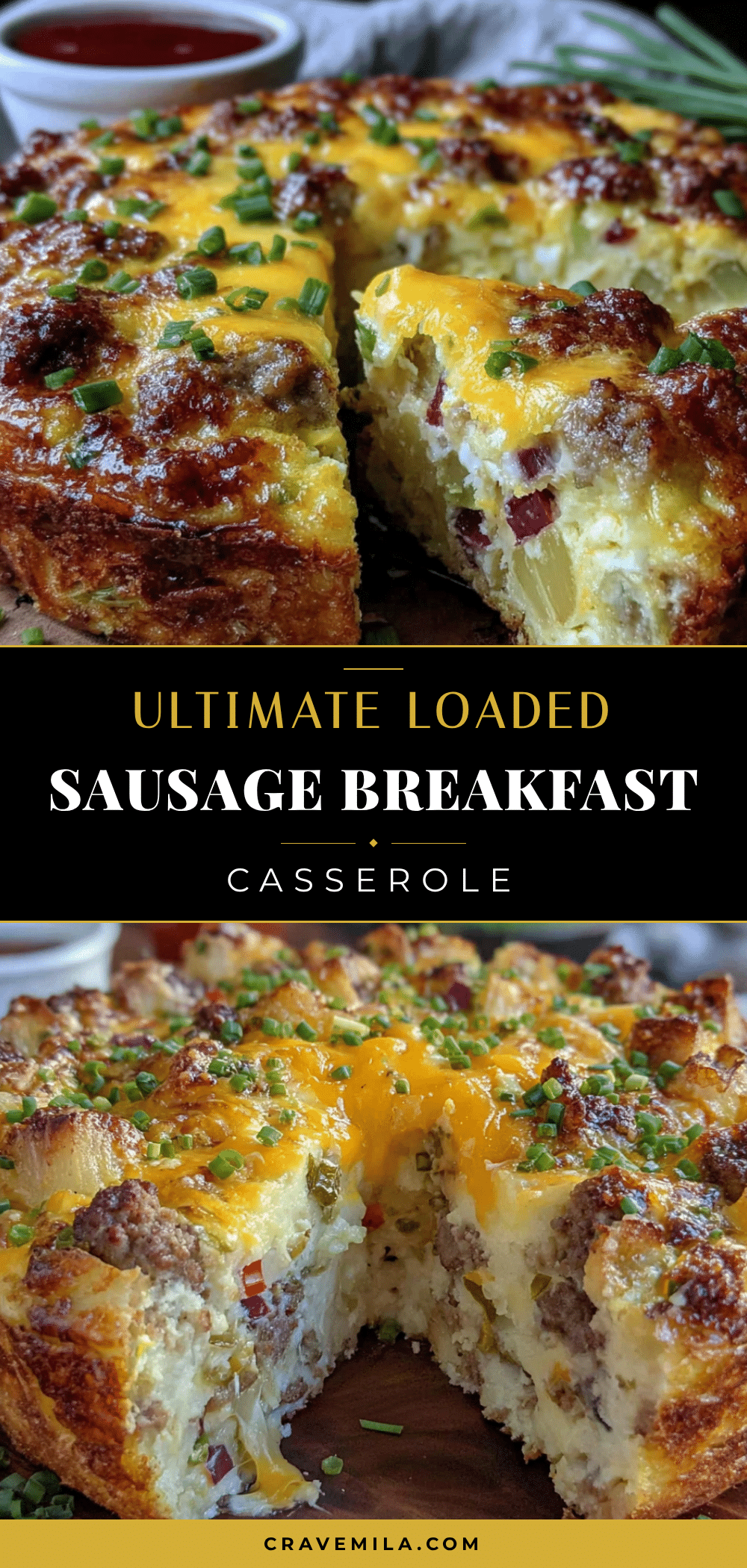
Ultimate Loaded Sausage Breakfast Casserole – Easy Make-Ahead Recipe

This Ultimate Loaded Sausage Breakfast Casserole is a hearty, cheesy, and satisfying make-ahead dish perfect for brunches, holiday mornings, or lazy weekends. With creamy eggs, crispy edges, and layers of sausage, cheese, and vegetables, it’s a crowd-pleaser that simplifies your morning.
- Prep Time: 30 minutes
- Cook Time: 50-55 minutes
- Total Time: 1 hour 20-25 minutes
- Yield: 8 servings 1x
- Category: Main Course
- Cuisine: American
Ingredients
- 1 pound breakfast sausage (raw crumbles, e.g., Jimmy Dean)
- 8 large eggs (room temperature preferred)
- 2 cups whole milk (2% works, but not skim)
- 1 teaspoon Dijon mustard
- 1/2 teaspoon garlic powder
- 1/2 teaspoon onion powder
- 1/2 teaspoon smoked paprika (regular paprika works)
- 1/4 teaspoon black pepper
- 1/2 teaspoon salt
- 6 cups cubed bread (stale or day-old sourdough or French bread)
- 2 cups shredded sharp cheddar cheese (shredded from a block)
- 1 cup shredded mozzarella cheese
- 1 medium onion, diced (yellow or white)
- 1 bell pepper, diced (any color)
- 2 tablespoons unsalted butter
- Fresh chives or parsley for garnish (optional)
Instructions
- Preheat your oven to 350°F (175°C). Grease a 9×13-inch baking dish with 2 tablespoons of butter.
- In a large skillet over medium heat, cook the breakfast sausage, breaking it up with a spatula, until browned and crispy (6-8 minutes). Leave about 1 tablespoon of fat in the pan. Transfer sausage to a plate using a slotted spoon.
- In the same skillet with the sausage drippings, sauté the diced onion and bell pepper over medium heat for 4-5 minutes until softened. Transfer to the plate with the sausage.
- In a large mixing bowl, whisk together the eggs, milk, Dijon mustard, garlic powder, onion powder, smoked paprika, black pepper, and salt until well combined and slightly frothy (about 30 seconds).
- Spread the cubed bread evenly in the greased baking dish. Do not pack it down.
- Sprinkle the cooked sausage and sautéed vegetables evenly over the bread. Gently nestle some into the bread.
- Sprinkle 1 cup of cheddar and 1/2 cup of mozzarella over the sausage and bread. Reserve the remaining cheese for the top.
- Slowly pour the egg mixture over everything in a zigzag pattern. Gently press down with a spatula to help the liquid soak in. Let sit for 5 minutes at room temperature.
- Sprinkle the remaining 1 cup of cheddar and 1/2 cup of mozzarella over the top.
- Cover the dish with aluminum foil and bake for 30 minutes.
- Remove the foil and bake for another 20-25 minutes, until the top is golden brown and bubbly, and the center is set (a knife inserted in the middle comes out clean). For extra browning, broil for the last 2 minutes, watching closely.
- Let the casserole rest for 10 minutes before serving. Garnish with fresh chives or parsley if desired.
Notes
For make-ahead: Assemble everything except the final cheese layer the night before. Add cheese just before baking. Let the casserole sit at room temperature for 20 minutes before baking if refrigerated. For gluten-free, use sturdy gluten-free bread. For dairy-free, use unsweetened oat milk and dairy-free cheese (add in last 10 minutes of baking). Internal temperature should reach 160°F (71°C). Leftovers keep in the fridge for up to 4 days or freeze for up to 3 months.
Nutrition
- Serving Size: 1 square (1/8 of cas
- Calories: 485
- Sugar: 6
- Sodium: 820
- Fat: 32
- Carbohydrates: 22
- Fiber: 2
- Protein: 28
Keywords: breakfast casserole, sausage casserole, make-ahead breakfast, loaded breakfast casserole, holiday brunch, egg casserole