I was standing in the frozen food aisle last November, staring at a bag of pre-chopped stew vegetables, when the cold air from the open freezer hit my face and suddenly I was seven years old in my Aunt Rita’s tiny kitchen. She wasn’t actually my aunt — she was our next-door neighbor, a retired schoolteacher with gnarled hands and the patience of a saint. The smell of beef browning in her heavy pot would drift through the screen door every single Sunday afternoon, and I’d find any excuse to “accidentally” end up on her back porch. She never shooed me away. She’d just hand me a wooden spoon and tell me to stir until my arm got tired.
That bag of frozen vegetables looked sad and lonely, honestly. It had no business being in the same sentence as what Aunt Rita made. So I put it back, grabbed a cart of actual root vegetables, and decided it was time to recreate that feeling — not just the stew, but the whole moment. The way her kitchen smelled like thyme and patience. The way the windows fogged up so you couldn’t see the gray November sky. The way she’d let me taste the broth from a spoon and ask, “Needs more salt, doesn’t it?”
This cozy slow cooker beef & root vegetable stew is my attempt to bottle that Sunday afternoon feeling. It’s not fancy — it’s not supposed to be. It’s the kind of meal that makes you slow down, the kind that fills your house with a smell that says everything is going to be okay. Maybe you’ve had one of those days where you just need a bowl of something warm and honest. Yeah, this is that bowl.
Why You’ll Love This Recipe
Let me tell you why this stew has become my go-to for those days when I need a hug in a bowl. I’ve tested this recipe more times than I care to admit — some batches were too thin, some were too salty, one was so bland my husband politely asked if I’d forgotten something. But this version? This is the one.
- Truly Set-It-and-Forget-It: Fifteen minutes of prep in the morning, and dinner takes care of itself. No stirring, no watching, no stress. The slow cooker does all the heavy lifting while you go about your day.
- Pantry-Friendly Ingredients: Beef chuck, carrots, potatoes, onions, celery — these are things most of us have on hand or can grab without a second thought. No fancy trips to specialty stores required.
- Perfect for Meal Prep: This stew tastes even better the next day. Make it on Sunday, and you’ve got lunches sorted for half the week. The flavors just keep getting deeper and more complex.
- Crowd-Pleasing Comfort: I’ve served this to picky kids, vegetarian friends who made an exception, and my father-in-law who “doesn’t really like stew.” Every single bowl came back empty.
- Deep, Rich Flavor Without the Work: The secret is browning the beef first — I know, I know, it’s an extra step. But that ten minutes of patience is what transforms this from “fine” to “what’s your secret?” The slow cooker finishes the job, breaking down the beef until it’s fork-tender and the broth is velvety and rich.
This isn’t just another beef stew recipe. It’s the one where the vegetables actually hold their shape, the beef melts apart, and the broth has that deep, almost wine-like complexity that usually takes hours of simmering on the stove. It’s comfort food that doesn’t require a culinary degree — just a slow cooker and a little bit of faith.
What Ingredients You Will Need
This recipe uses simple, honest ingredients that work together to create something greater than the sum of their parts. Most of these are probably already in your kitchen, which is exactly how Aunt Rita would have wanted it.
For the Stew Base
- 2 pounds beef chuck, cut into 1½-inch cubes (look for well-marbled pieces — the fat equals flavor and tenderness)
- 3 tablespoons all-purpose flour (for dusting the beef — this helps thicken the stew naturally)
- 2 tablespoons olive oil, divided (use a good quality one for browning; I like California Olive Ranch)
- 1 large yellow onion, diced (about 1½ cups)
- 4 cloves garlic, minced (fresh only — the jarred stuff won’t give you the same depth)
- 2 tablespoons tomato paste (this is the secret to that rich, dark color and umami flavor)
- 1 cup dry red wine (something you’d actually drink — I use a Cabernet Sauvignon or Merlot; skip this and use extra broth if you prefer)
- 4 cups beef broth, low-sodium (better control over salt this way; I swear by Better Than Bouillon)
- 2 bay leaves (fresh or dried — just remember to remove them before serving)
- 1 teaspoon dried thyme (or 3 sprigs fresh if you have them)
- 1 teaspoon smoked paprika (adds a subtle smokiness that’s just magic)
- Salt and black pepper, to taste (start with 1 teaspoon salt and ½ teaspoon pepper)
For the Root Vegetables
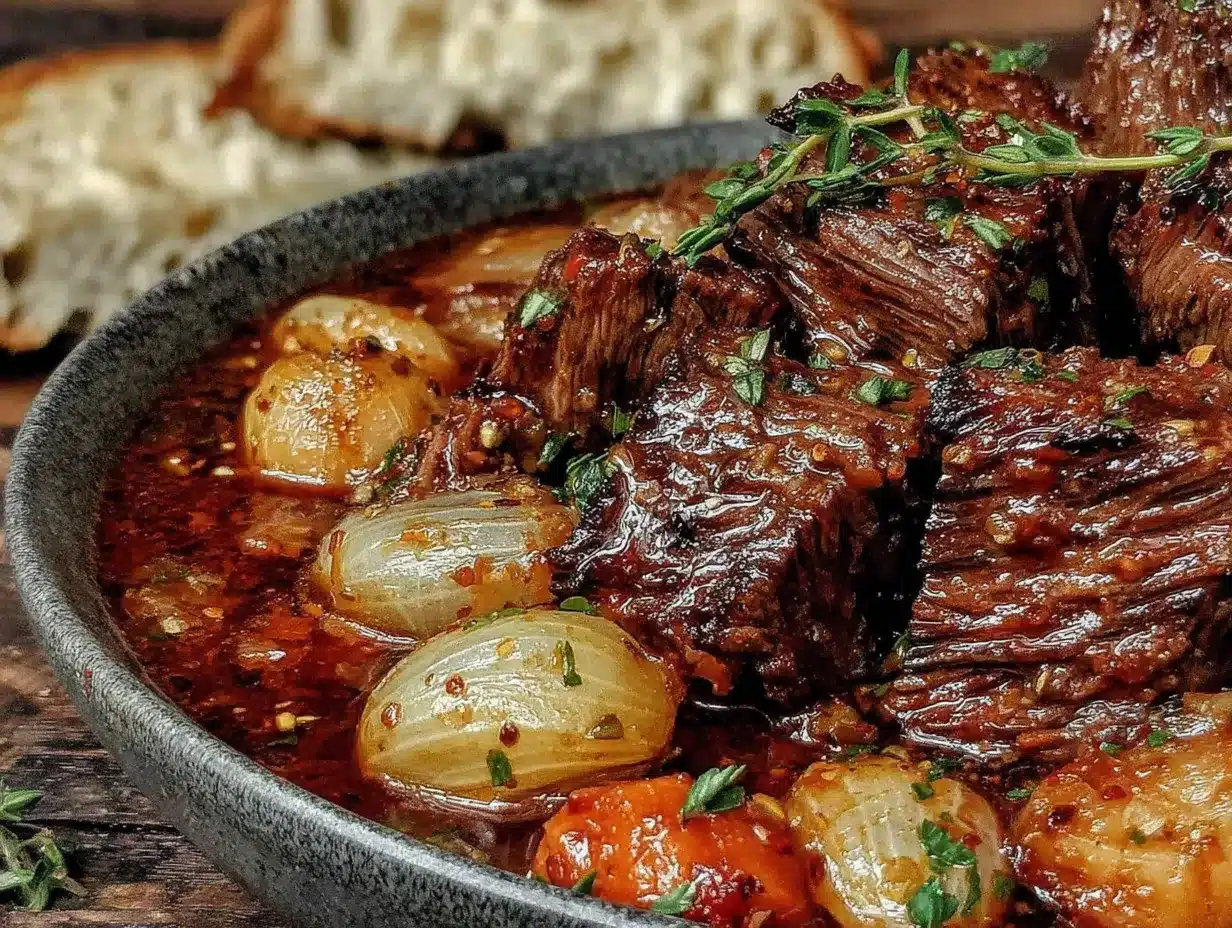
- 3 medium carrots, peeled and cut into 1-inch chunks (about 1½ cups)
- 3 stalks celery, sliced into ½-inch pieces (about 1 cup)
- 2 medium Yukon Gold potatoes, peeled and cut into 1-inch cubes (about 2 cups — they hold their shape better than Russets)
- 2 medium parsnips, peeled and cut into 1-inch chunks (about 1 cup — their peppery sweetness is non-negotiable here)
- 1 large turnip, peeled and cut into 1-inch cubes (about 1 cup — trust me on this one, even if you think you don’t like turnips)
- 1 cup frozen peas (add these at the very end, just to warm through)
For the Garnish (Optional but Recommended)
- Fresh parsley, chopped (a sprinkle of green makes everything look intentional)
- Crusty bread (for dipping — I’m partial to a good sourdough boule)
One thing I’ve learned the hard way — don’t skip browning the beef. I know it’s tempting to just toss everything in the slow cooker and walk away. I’ve done it. The result is edible, sure, but it’s pale and one-dimensional. That browned crust on the beef is where all the deep, savory flavor lives. It’s worth the extra ten minutes, I promise.
Equipment Needed
You don’t need a professional kitchen to make this stew, but having the right tools makes the process smoother. Here’s what you’ll need:
- 6-quart slow cooker (anything from 5 to 7 quarts works; smaller and you’ll have trouble fitting everything)
- Large heavy-bottomed skillet or Dutch oven (for browning the beef — cast iron is ideal, but any heavy pan will do)
- Sharp chef’s knife (a dull knife is more dangerous than a sharp one, and it makes cutting root vegetables a chore)
- Cutting board (preferably large enough to handle all those vegetables without crowding)
- Wooden spoon or spatula (for scraping up those browned bits — that’s where the flavor lives)
- Measuring cups and spoons (I use my Pyrex liquid measuring cup for the broth and wine)
- Tongs (for turning the beef while browning — much easier than a fork)
- Vegetable peeler (a good Y-peeler makes quick work of carrots and parsnips)
If you don’t have a slow cooker, you can absolutely make this in a Dutch oven on the stovetop or in the oven at 325°F for about 2½ hours. I’ve done it both ways, and honestly, the slow cooker version is more forgiving — you can leave it all day without worrying about it burning.
Preparation Method
Alright, let’s make some stew. This looks like a lot of steps, but I promise it’s mostly hands-off. Put on some music, pour yourself a glass of that wine you’re using for the stew, and enjoy the process.
- Prep your beef (5 minutes): Pat the beef cubes dry with paper towels. This is crucial — wet beef won’t brown properly. Season generously with salt and pepper, then toss with the flour until each piece is lightly coated. Shake off any excess flour.
- Brown the beef in batches (10-12 minutes): Heat 1 tablespoon of olive oil in your large skillet over medium-high heat until it shimmers. Add the beef in a single layer — don’t crowd the pan. You’ll need to do this in 2 or 3 batches. Let each piece cook undisturbed for 2-3 minutes until a deep brown crust forms, then flip and brown the other sides. Transfer the browned beef to your slow cooker. Resist the urge to move the beef around too much — let it develop that crust.
- Sauté the aromatics (5 minutes): Reduce the heat to medium and add the remaining tablespoon of oil to the now-empty skillet. Add the diced onion and cook, stirring occasionally, until softened and translucent — about 3-4 minutes. Add the minced garlic and cook for another 30 seconds until fragrant. Your kitchen should smell incredible at this point.
- Build the flavor base (3 minutes): Stir in the tomato paste and cook for 1-2 minutes, stirring constantly. It’ll darken and stick to the pan a bit — that’s exactly what you want. Pour in the red wine and use your wooden spoon to scrape up all those browned bits from the bottom of the pan. Let the wine simmer for 2 minutes until it reduces slightly. Pour this whole mixture into the slow cooker over the beef.
- Layer in the vegetables (5 minutes): Add the carrots, celery, potatoes, parsnips, and turnip to the slow cooker. Don’t stir too much — you want the vegetables to stay somewhat separate so they cook evenly. Tuck the bay leaves in among the vegetables.
- Add the liquid and seasonings (2 minutes): Pour in the beef broth, then add the dried thyme and smoked paprika. Give everything a gentle stir — just enough to combine, but not so much that you break up the vegetables. The liquid should mostly cover the ingredients; if it doesn’t, add a splash more broth or water.
- Cook low and slow (6-8 hours on low, or 4-5 hours on high): Cover and cook on LOW for 7-8 hours or on HIGH for 4-5 hours. I strongly recommend LOW — the longer cooking time breaks down the connective tissue in the beef and allows the flavors to meld in a way that high heat just can’t replicate. Your house will smell like a cozy Sunday afternoon for the entire day.
- Add the peas and adjust seasoning (5 minutes before serving): About 5 minutes before you’re ready to serve, stir in the frozen peas. They don’t need to cook — just warm through. Taste the broth and adjust salt and pepper as needed. Remove the bay leaves — they’ve done their job.
- Rest and serve (10 minutes): Let the stew sit for about 10 minutes after cooking. This allows the flavors to settle and the broth to thicken slightly. Ladle into bowls, garnish with fresh parsley, and serve with crusty bread for dipping.
A few things I’ve learned the hard way: if your stew seems too thin at the end, you can mix 2 tablespoons of cornstarch with 2 tablespoons of cold water and stir it in. Let it cook for another 10 minutes, and it’ll thicken right up. Also, don’t skip the resting time — I know you’ll be hungry, but that short wait makes a real difference in the texture.
Cooking Tips & Techniques
After making this stew more times than I can count (and messing it up plenty along the way), here are the things I wish someone had told me:
Don’t skip the browning step. I know I’ve said this already, but it bears repeating. The Maillard reaction — that chemical process that creates the brown crust on meat — is responsible for most of the deep, savory flavor in this stew. One time I was in a rush and skipped it, and the stew was… fine. But fine isn’t what we’re going for here.
Cut your vegetables to a uniform size. This is one of those things that seems fussy but actually matters. If your potato chunks are twice the size of your carrot chunks, you’ll end up with mushy carrots and undercooked potatoes. Aim for 1-inch cubes across the board.
Layer your ingredients strategically. Put the beef on the bottom of the slow cooker, then the harder vegetables (carrots, turnips, parsnips), then the softer ones (potatoes) on top. The beef and harder vegetables need more time to cook, so they benefit from being closer to the heat source.
Resist the urge to peek. Every time you lift that lid, you release heat and add about 20 minutes to your cooking time. I know it’s tempting to check on it — I’ve been there. But trust the process. Your stew is doing exactly what it needs to do in there.
Season in layers. Season the beef before browning, season the broth when you add it, and season again at the end. This creates depth of flavor that you just can’t get from adding all the salt at once.
One of my biggest failures? I once added the peas at the beginning of cooking because I wanted to “save time.” They turned into sad, gray, mushy orbs that added nothing to the stew. Patience, my friends. Peas go in at the end.
Variations & Adaptations
This stew is wonderfully adaptable, and I’ve tried quite a few variations over the years. Here are some of my favorites:
Make it gluten-free: Skip the flour when dusting the beef, or use a gluten-free all-purpose flour blend. The stew will still thicken nicely from the natural starches in the potatoes and the slow cooking process.
Make it dairy-free: This recipe is already dairy-free as written, so you’re good to go. If you’re serving it with bread, just make sure your bread is dairy-free too.
Swap the protein: Beef chuck is my favorite, but this works beautifully with lamb shoulder or even boneless short ribs. If you’re feeling adventurous, try it with cubed pork shoulder — it’s a different flavor profile but equally delicious.
Change up the vegetables: This is a root vegetable stew at heart, but feel free to swap based on what’s in season. Sweet potatoes, rutabaga, celeriac, or even butternut squash all work beautifully. In the summer, I sometimes add zucchini in the last 30 minutes of cooking.
Add some heat: If you like a little kick, add a chopped chipotle pepper in adobo sauce along with the tomato paste. The smokiness pairs beautifully with the beef and root vegetables.
Herb variations: Rosemary is a lovely addition — add a sprig along with the thyme. Or try a teaspoon of dried oregano for a slightly different Mediterranean vibe.
One of my personal favorite variations is to add a parmesan rind to the slow cooker while it cooks. It adds an incredible savory depth that’s hard to describe. Just fish it out before serving.
Serving & Storage Suggestions
This stew is at its best served piping hot in deep bowls, with a generous hunk of crusty bread on the side for sopping up every last drop of that glorious broth. A sprinkle of fresh parsley adds color and freshness, and if you’re feeling fancy, a dollop of horseradish cream or gremolata takes it to another level.
For wine pairings, you can’t go wrong with the same red wine you used in the stew — a Cabernet Sauvignon or Merlot works beautifully. If you prefer beer, a dark stout or porter is a cozy companion.
Storage: This stew is one of those magical dishes that tastes better the next day. Let it cool completely, then transfer to an airtight container. It will keep in the refrigerator for up to 5 days. The flavors will continue to meld and deepen, making day-two stew something truly special.
Freezing: This freezes like a dream. Portion the cooled stew into freezer-safe containers or zip-top bags, leaving a little room for expansion. It will keep for up to 3 months. Thaw overnight in the refrigerator before reheating.
Reheating: The best way to reheat is gently on the stovetop over medium-low heat, stirring occasionally. Add a splash of broth or water if the stew has thickened too much. You can also microwave individual portions, but the stovetop method preserves the texture of the vegetables better.
One thing I’ve noticed — the potatoes will absorb more liquid as the stew sits, so it will naturally thicken over time. If your leftovers seem more like a pot roast than a stew, just add a little broth when reheating.
Nutritional Information & Benefits
Per serving (based on 8 servings), this stew provides approximately:
- Calories: 385
- Protein: 32g
- Fat: 14g
- Carbohydrates: 28g
- Fiber: 6g
- Sugar: 8g
- Sodium: 680mg (varies based on broth and added salt)
This stew is packed with nutritional benefits. Beef chuck is an excellent source of high-quality protein, iron, and B vitamins — particularly B12, which is essential for energy and brain function. The root vegetables provide a wealth of fiber, vitamins, and antioxidants. Carrots are loaded with beta-carotene for eye health, parsnips offer folate and vitamin C, and turnips provide a good dose of vitamin C and fiber.
The slow cooking method also helps preserve nutrients that might be lost with higher-heat cooking methods. And because this stew is so satisfying, you’re less likely to reach for less nutritious options later in the evening.
If you’re watching your sodium, use low-sodium broth and go easy on the added salt — you can always add more at the table.
Conclusion
This cozy slow cooker beef & root vegetable stew is more than just a recipe — it’s a Sunday afternoon in a bowl. It’s the smell that fills your house and makes everyone wander into the kitchen asking, “What’s for dinner?” It’s the kind of meal that slows you down, that reminds you to take a breath and actually taste what you’re eating.
I’ve made this stew on busy weeknights when I needed dinner to take care of itself. I’ve made it for friends who were going through hard times, because some things can only be said with a warm bowl of something homemade. And I’ve made it just for myself, on cold rainy days when I needed a little comfort.
The best part? You can make it your own. Add more garlic if that’s your thing. Swap in sweet potatoes for the turnips. Throw in some mushrooms if you have them. This recipe is a starting point, not a rulebook. The only non-negotiable is that you brown that beef — everything else is up to you.
I’d love to hear how this turns out for you. Did you add something unexpected? Did your family go back for seconds? Drop a comment below and let me know — your variations might inspire someone else’s dinner tonight.
Now go make some stew. Your future self will thank you.
Frequently Asked Questions
Can I make this stew without wine?
Absolutely. Just replace the wine with an equal amount of beef broth. You’ll lose a little depth, but the stew will still be delicious. Some people add a splash of balsamic vinegar or Worcestershire sauce to mimic that complexity.
Can I use frozen vegetables instead of fresh?
You can, but I don’t recommend it for the root vegetables — frozen ones tend to get mushy during the long cooking time. Frozen peas are fine since they go in at the end. For the carrots, parsnips, and turnips, fresh is definitely better here.
Why is my stew watery?
Several possible reasons: you might have used too much broth, cut your vegetables too small (they break down and release water), or cooked on high heat. Next time, reduce the broth by half a cup and make sure your beef is well-coated in flour before browning.
Can I cook this on the stovetop instead of a slow cooker?
Yes! Brown the beef in a Dutch oven, then add all the ingredients except the peas. Bring to a simmer, cover, and cook on low heat for 2 to 2½ hours, until the beef is tender. Add the peas in the last 5 minutes. Check the liquid level occasionally and add more broth if needed.
How do I prevent my potatoes from turning mushy?
Cut them into larger chunks (about 1½ inches) and place them on top of the other vegetables in the slow cooker. They’ll steam rather than sit in the liquid, which helps them hold their shape. Yukon Gold potatoes also hold up better than Russets.
Pin This Recipe!
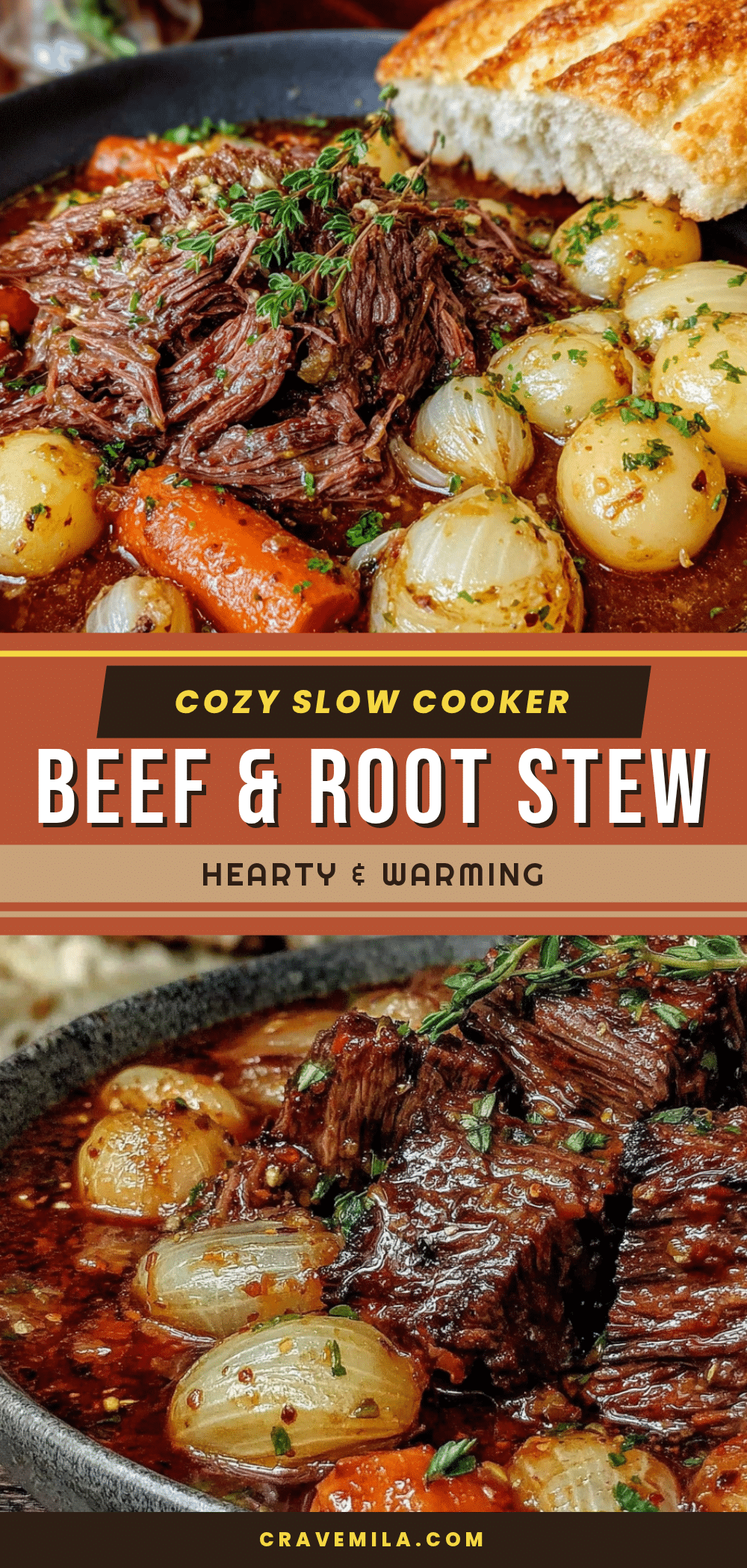
Cozy Slow Cooker Beef & Root Vegetable Stew: Easy One-Pot Meal
This cozy slow cooker beef & root vegetable stew is a comforting one-pot meal that fills your house with a warm, inviting aroma. With tender beef, hearty root vegetables, and a rich, savory broth, it’s the perfect set-it-and-forget-it dinner for busy days.
- Prep Time: 15 minutes
- Cook Time: 7-8 hours on low or 4-5 hours on high
- Total Time: 7 hours 15 minutes to 8 hours 15 minutes
- Yield: 8 servings 1x
- Category: Main Course
- Cuisine: American
Ingredients
- 2 pounds beef chuck, cut into 1½-inch cubes
- 3 tablespoons all-purpose flour
- 2 tablespoons olive oil, divided
- 1 large yellow onion, diced (about 1½ cups)
- 4 cloves garlic, minced
- 2 tablespoons tomato paste
- 1 cup dry red wine (such as Cabernet Sauvignon or Merlot)
- 4 cups low-sodium beef broth
- 2 bay leaves
- 1 teaspoon dried thyme
- 1 teaspoon smoked paprika
- Salt and black pepper, to taste (start with 1 teaspoon salt and ½ teaspoon pepper)
- 3 medium carrots, peeled and cut into 1-inch chunks (about 1½ cups)
- 3 stalks celery, sliced into ½-inch pieces (about 1 cup)
- 2 medium Yukon Gold potatoes, peeled and cut into 1-inch cubes (about 2 cups)
- 2 medium parsnips, peeled and cut into 1-inch chunks (about 1 cup)
- 1 large turnip, peeled and cut into 1-inch cubes (about 1 cup)
- 1 cup frozen peas
- Fresh parsley, chopped (for garnish)
- Crusty bread (for serving)
Instructions
- Prep your beef: Pat the beef cubes dry with paper towels. Season generously with salt and pepper, then toss with the flour until each piece is lightly coated. Shake off any excess flour.
- Brown the beef in batches: Heat 1 tablespoon of olive oil in a large skillet over medium-high heat until it shimmers. Add the beef in a single layer (in 2 or 3 batches) and cook undisturbed for 2-3 minutes until a deep brown crust forms, then flip and brown the other sides. Transfer the browned beef to a 6-quart slow cooker.
- Sauté the aromatics: Reduce the heat to medium and add the remaining tablespoon of oil to the skillet. Add the diced onion and cook, stirring occasionally, until softened and translucent, about 3-4 minutes. Add the minced garlic and cook for another 30 seconds until fragrant.
- Build the flavor base: Stir in the tomato paste and cook for 1-2 minutes, stirring constantly. Pour in the red wine and use a wooden spoon to scrape up the browned bits from the bottom of the pan. Let the wine simmer for 2 minutes until it reduces slightly. Pour this mixture into the slow cooker over the beef.
- Layer in the vegetables: Add the carrots, celery, potatoes, parsnips, and turnip to the slow cooker. Tuck the bay leaves in among the vegetables.
- Add the liquid and seasonings: Pour in the beef broth, then add the dried thyme and smoked paprika. Give everything a gentle stir to combine.
- Cook low and slow: Cover and cook on LOW for 7-8 hours or on HIGH for 4-5 hours.
- Add the peas and adjust seasoning: About 5 minutes before serving, stir in the frozen peas. Taste the broth and adjust salt and pepper as needed. Remove the bay leaves.
- Rest and serve: Let the stew sit for about 10 minutes after cooking. Ladle into bowls, garnish with fresh parsley, and serve with crusty bread for dipping.
Notes
Don’t skip browning the beef—it adds deep flavor. Cut vegetables to a uniform size for even cooking. Layer ingredients with beef on the bottom, harder vegetables next, and softer ones on top. Resist lifting the lid during cooking. Season in layers for best flavor. If stew is too thin, mix 2 tablespoons cornstarch with 2 tablespoons cold water and stir in; cook 10 more minutes. Let stew rest 10 minutes before serving.
Nutrition
- Serving Size: 1 bowl (about 1½ cup
- Calories: 385
- Sugar: 8
- Sodium: 680
- Fat: 14
- Saturated Fat: 4
- Carbohydrates: 28
- Fiber: 6
- Protein: 32
Keywords: slow cooker beef stew, root vegetable stew, comfort food, one-pot meal, beef stew, winter stew